The Zubrick Organic Chemistry Survival Manual, a cornerstone for students, offers practical guidance through challenging laboratory techniques and reaction intricacies.
This invaluable resource, frequently updated and available through platforms like WileyPLUS and the Folkscanomy archive, empowers chemists with essential skills.
Overview of the Manual’s Purpose
The core purpose of the Zubrick Organic Chemistry Survival Manual is to bridge the gap between theoretical knowledge and practical application within the organic chemistry laboratory. It’s designed as a comprehensive, hands-on guide, prioritizing techniques crucial for successful experimentation and problem-solving.
Unlike traditional textbooks, Zubrick’s manual focuses intensely on “how to” rather than solely “what is.” It emphasizes proactive troubleshooting, recognizing that reactions frequently deviate from ideal outcomes. The manual champions a pragmatic approach, advocating for techniques like Thin Layer Chromatography (TLC) as an indispensable tool for monitoring reaction progress – essentially, providing “eyes” into the reaction itself.
Furthermore, it stresses the importance of meticulous solvent handling, including drying, degassing, and purification, acknowledging that seemingly inert solvents often contain impurities that can drastically impact results. Ultimately, the manual aims to instill confidence and resourcefulness in students and researchers alike, fostering a mindset where failure is viewed not as defeat, but as a valuable learning opportunity.
Target Audience: Students and Researchers
The Zubrick Organic Chemistry Survival Manual primarily targets students navigating the complexities of organic chemistry laboratory courses, from introductory undergraduate levels through advanced graduate studies. It serves as a vital companion, supplementing textbook theory with practical, real-world guidance.
However, its utility extends far beyond the academic realm. Research scientists, both seasoned professionals and those newly entering the field, also find the manual invaluable. The detailed protocols and troubleshooting advice are applicable to a wide range of synthetic chemistry projects.
The manual’s strength lies in its accessibility; it doesn’t assume prior expertise, instead building skills from the ground up. It’s particularly beneficial for individuals working independently or in environments where immediate mentorship isn’t readily available. The manual’s comprehensive coverage, including NMR spectroscopy (COSY, HSQC, HMBC), makes it a go-to resource for anyone seeking to refine their experimental technique and achieve reliable results.
Essential Laboratory Techniques
The Zubrick Manual expertly details crucial techniques like Thin Layer Chromatography (TLC), NMR spectroscopy, and proper solvent handling, vital for successful experimentation.
Thin Layer Chromatography (TLC) ⏤ A Primary Tool
The Zubrick Manual emphatically stresses the importance of Thin Layer Chromatography (TLC), positioning it as an indispensable tool for organic chemistry students and researchers alike.
It’s not merely a technique, but a “friend” that provides crucial “eyes into your reaction,” offering rapid qualitative analysis of reaction progress and product purity.
By utilizing TLC, chemists can efficiently monitor transformations, determine optimal reaction times, and identify the presence of starting materials, products, or byproducts.
This proactive approach saves valuable time and resources, preventing wasted effort on unproductive reactions. The manual provides detailed guidance on TLC plate preparation, spotting techniques, solvent system selection, and visualization methods, ensuring users can confidently leverage this powerful analytical method.
Mastering TLC, as Zubrick advocates, is fundamental to efficient and successful organic synthesis.
NMR Spectroscopy: A Deep Dive
The Zubrick Manual dedicates significant attention to Nuclear Magnetic Resonance (NMR) Spectroscopy, recognizing its central role in structure elucidation within organic chemistry.
The manual doesn’t just cover basic 1H NMR; it delves into advanced techniques like COSY, HSQC, and HMBC, equipping students with the skills to tackle complex spectral analyses.
Understanding these 2D NMR methods is crucial for establishing connectivity between atoms within a molecule, ultimately confirming its structure.
Zubrick’s approach emphasizes a practical understanding, guiding users through spectral interpretation and correlation of data. The manual stresses the importance of recognizing key NMR parameters, such as chemical shifts, coupling constants, and integration values.
Proficiency in NMR, as highlighted by Zubrick, is essential for confident compound identification and reaction validation.
COSY, HSQC, and HMBC Techniques

Zubrick’s Manual expertly breaks down the intricacies of advanced NMR techniques – COSY (Correlation Spectroscopy), HSQC (Heteronuclear Single Quantum Coherence), and HMBC (Heteronuclear Multiple Bond Correlation).
COSY reveals proton-proton connectivity, identifying which hydrogens are coupled to each other within the molecule. HSQC establishes direct one-bond correlations between protons and carbons, providing a foundational understanding of the carbon-hydrogen framework.
Crucially, HMBC unveils long-range, two-to-four bond correlations between protons and carbons, allowing for the complete mapping of molecular connectivity.
The manual emphasizes a step-by-step approach to interpreting these spectra, enabling students to confidently assign signals and deduce structural information. Zubrick stresses that mastering these techniques is paramount for successful structure determination.
These methods, when combined, provide a powerful toolkit for unraveling complex molecular structures.
Solvent Handling and Purification
Zubrick’s Manual dedicates significant attention to solvent handling and purification, recognizing their critical impact on reaction success. It emphatically states that “all solvent is wet and filled with O2,” highlighting the necessity for careful preparation.
The manual details methods for drying and degassing solvents, crucial for air- and water-sensitive reactions. Techniques like utilizing molecular sieves are thoroughly explained, including proper activation procedures.
Furthermore, Zubrick guides users through the operation of solvent purification systems, offering practical advice for maintaining solvent quality. He also covers the freeze-pump-thaw technique for removing dissolved gases.
The manual underscores that neglecting solvent purity is a common source of experimental failure, emphasizing proactive solvent treatment as a fundamental laboratory practice. Proper solvent handling is non-negotiable.
Drying and Degassing Solvents
Zubrick’s Manual stresses the paramount importance of drying and degassing solvents before use, particularly for reactions susceptible to air or moisture. The manual directly states that unless proven otherwise, assume “all solvent is wet and filled with O2.”
Effective drying methods detailed include utilizing drying agents like molecular sieves, with specific instructions on their proper activation to maximize efficiency. The manual emphasizes that simply adding sieves isn’t enough; correct activation is key.
Degassing techniques, such as repeated freeze-pump-thaw cycles, are also explained to remove dissolved oxygen. These methods prevent unwanted side reactions and ensure optimal reaction conditions.
Zubrick’s approach is pragmatic, recognizing that even seemingly dry solvents can contain enough impurities to compromise results. Diligence in solvent preparation is presented as a foundational skill.
Solvent Purification Systems
The Zubrick Manual highlights the significant advantages of employing solvent purification systems for obtaining consistently high-quality solvents. These systems offer a convenient alternative to traditional distillation or drying methods, saving valuable time and resources in the laboratory.
The manual doesn’t delve into specific brands, but emphasizes understanding the underlying principles of operation – typically involving passing a solvent through columns of drying agents and alumina to remove water, oxygen, and peroxides.
Proper maintenance and monitoring of these systems are crucial, including regular replacement of drying agents to ensure continued effectiveness. Zubrick stresses that even with a system, verification of dryness is still recommended.
These systems are presented as a practical solution for labs requiring large volumes of anhydrous and deoxygenated solvents, streamlining workflows and improving experimental reproducibility.
Activation of Molecular Sieves & Freeze-Pump-Thaw Techniques
The Zubrick Manual dedicates attention to the critical processes of activating molecular sieves and employing freeze-pump-thaw techniques for achieving truly anhydrous conditions. Molecular sieves, he explains, require rigorous activation – typically through heating under vacuum – to remove adsorbed water before use.
The manual details the importance of proper heating protocols to avoid damaging the sieves. Freeze-pump-thaw cycles, conversely, involve freezing a solvent, evacuating the system, and then allowing the solvent to thaw, repeating this process multiple times to remove dissolved gases.
Zubrick emphasizes that these techniques are often complementary; sieves dry the solvent, while freeze-pump-thaw removes dissolved oxygen and other volatile impurities. He cautions against complacency, stressing the need to verify dryness even after these procedures.
These methods are presented as essential tools for reactions sensitive to even trace amounts of water or oxygen.
Reaction Considerations & Troubleshooting

Zubrick’s manual stresses anticipating air and water sensitivity, embracing failure as a learning tool, and designing rapid “go/no-go” experiments for efficient progress.
Air and Water Sensitivity in Reactions
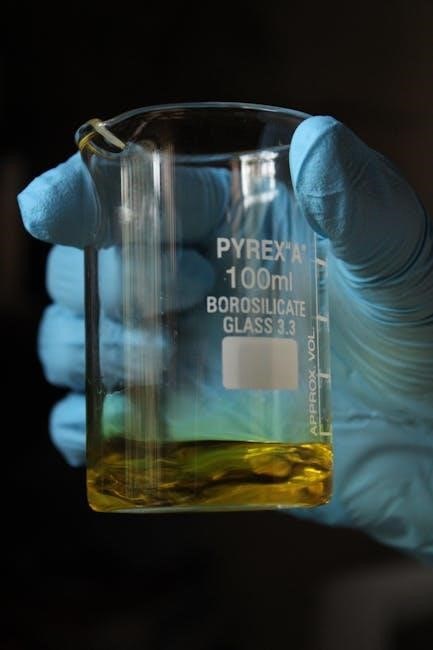
The Zubrick manual emphatically highlights the pervasive issue of solvent wetness and oxygen contamination, advising that “all solvent is wet and filled with O2.” This isn’t merely a cautionary note, but a fundamental principle for successful organic synthesis.
Unless a reaction is definitively proven to be inert to atmospheric conditions, meticulous drying and degassing of solvents are paramount. Techniques detailed within the manual include proper activation of molecular sieves – crucial for removing trace water – and the effective implementation of freeze-pump-thaw cycles to eliminate dissolved oxygen.
Ignoring these precautions can lead to unpredictable results, diminished yields, and the formation of unwanted byproducts. Zubrick’s approach isn’t about avoiding air and water-sensitive reactions, but about mastering the techniques to control them, ensuring reliable and reproducible outcomes in the laboratory.
Embracing Failure as a Learning Opportunity
The Zubrick manual doesn’t shy away from the reality of research: “Most reactions will fail.” This isn’t presented as discouraging, but as a foundational truth. The manual reframes failure not as a reflection of inadequacy, but as an inherent part of pushing the boundaries of chemical knowledge.
It acknowledges that the “easy stuff has already been done,” and that researchers are often tackling inherently challenging problems. Zubrick emphasizes that difficulty doesn’t equate to incompetence; it signifies an opportunity for learning and refinement.
The core message is to “fail fast,” advocating for the design of “fast go/no-go” experiments to quickly assess the viability of a project and pivot when necessary, maximizing efficiency and minimizing wasted effort.
Fast Go/No-Go Experiment Design
The Zubrick Organic Chemistry Survival Manual strongly advocates for strategic experimental design centered around rapid assessment. This “fast go/no-go” approach is crucial for efficient research, particularly when facing challenging reactions or novel synthetic routes.
Instead of investing significant time and resources into lengthy, complex procedures, the manual encourages chemists to devise concise experiments specifically designed to provide quick, definitive answers. These experiments should focus on identifying critical factors that determine the success or failure of a reaction.
If initial tests indicate a project is unlikely to yield positive results, the manual advises a swift “pivot” to alternative strategies, conserving valuable time and resources. This pragmatic approach is central to Zubrick’s philosophy.
Specific Content Areas Covered

The Zubrick Manual comprehensively details natural sciences, chemistry foundations, and crucial laboratory techniques, offering a robust guide for both students and experienced researchers alike.
Natural Sciences & Chemistry Foundations
The Zubrick Organic Chemistry Survival Manual doesn’t assume prior mastery; it reinforces fundamental principles within natural sciences and chemistry. It serves as a bridge, revisiting core concepts essential for successful laboratory work and advanced understanding.
This includes a solid grounding in chemical bonding, molecular structure, and the principles governing reactivity. The manual doesn’t simply present techniques in isolation; it contextualizes them within the broader framework of chemical theory.
Understanding these foundations is paramount, as the manual prepares students to not only perform reactions but also to comprehend the underlying mechanisms driving them. This approach fosters a deeper, more lasting grasp of organic chemistry, moving beyond rote memorization towards genuine scientific insight.
Laboratory Techniques Detailed in the Manual
The Zubrick Organic Chemistry Survival Manual meticulously details a comprehensive suite of laboratory techniques crucial for organic chemists. Thin Layer Chromatography (TLC) receives significant emphasis, rightly touted as an indispensable “friend” for monitoring reactions and assessing purity – truly the “eyes into your reaction”.
Furthermore, the manual provides an in-depth exploration of NMR Spectroscopy, specifically focusing on 1H NMR, alongside advanced techniques like COSY, HSQC, and HMBC for complete structural elucidation.
Beyond analysis, practical skills like proper solvent handling, drying, degassing, and utilizing solvent purification systems are thoroughly covered, alongside techniques for activating molecular sieves and employing freeze-pump-thaw methods.
The Zubrick Magic Theatre (Contextual Note)
Interestingly, the name “Zubrick” also references a spectacular performance art venue, showcasing illusion and comedy, a delightful contrast to the manual’s scientific rigor.
Distinction between Scientific Manual and Performance Art
While sharing a surname, the Organic Chemistry Lab Survival Manual by James W. Zubrick and the “Zubrick Magic Theatre” represent vastly different domains of expertise and experience.
The manual is a pragmatic guide, focused on the meticulous details of chemical experimentation – TLC, NMR spectroscopy, solvent purification, and troubleshooting reactions. It prioritizes accuracy, reproducibility, and a deep understanding of chemical principles.
Conversely, the theatre is dedicated to illusion, entertainment, and captivating audiences with sleight-of-hand and grand-scale illusions. It thrives on creating wonder and suspending disbelief.
The connection is purely nominal; one is a rigorous scientific text, the other a vibrant performance art venue. However, both require a degree of skill, precision, and a captivating presentation – albeit in entirely different contexts!
Resources and Availability
The Zubrick Manual is accessible via WileyPLUS integration and various editions, including those paired with organic chemistry texts.
Additionally, a digital archive exists on Folkscanomy, broadening its reach.
WileyPLUS Integration and Editions
WileyPLUS offers a seamless integration with the Zubrick Organic Chemistry Survival Manual, providing students with interactive learning tools and resources. This digital platform often bundles the manual with core organic chemistry textbooks, such as those authored by David R. Klein, creating a comprehensive learning package.
Several editions exist, reflecting updates and refinements to the content. For instance, the manual has been paired with Klein’s “Organic Chemistry As a Second Language” in both its third edition set and alongside the 9th Edition of the core textbook. These combinations ensure students have access to both foundational knowledge and practical laboratory guidance.
The WileyPLUS integration typically includes self-assessment quizzes, practice problems, and access to supplementary materials, enhancing the learning experience and solidifying understanding of key concepts presented within the manual. Students benefit from the convenience of having all necessary resources in one centralized location.
Folkscanomy Digital Archive Access
The Organic Chem Lab Survival Manual by James W. Zubrick is readily accessible through the Folkscanomy digital archive, a valuable resource for students and researchers seeking free access to scanned scientific literature. This archive provides a digitized version of the manual, offering an alternative to purchasing a physical copy or accessing it through WileyPLUS.
The Folkscanomy entry details the manual as part of their “folkscanomy_science” collection, categorized under “Natural Sciences” and “Chemistry.” The scanned document is approximately 126.9MB in size and was added to the archive on April 30, 2011. It utilizes OCR (Optical Character Recognition) technology, processed by ABBYY FineReader 8.0, to enable text searching.
While the scan quality may vary, Folkscanomy offers a convenient way to consult the manual’s contents, particularly for those with limited access to traditional resources. The archive’s commitment to preserving and sharing scientific knowledge makes it a beneficial platform for the chemistry community.